
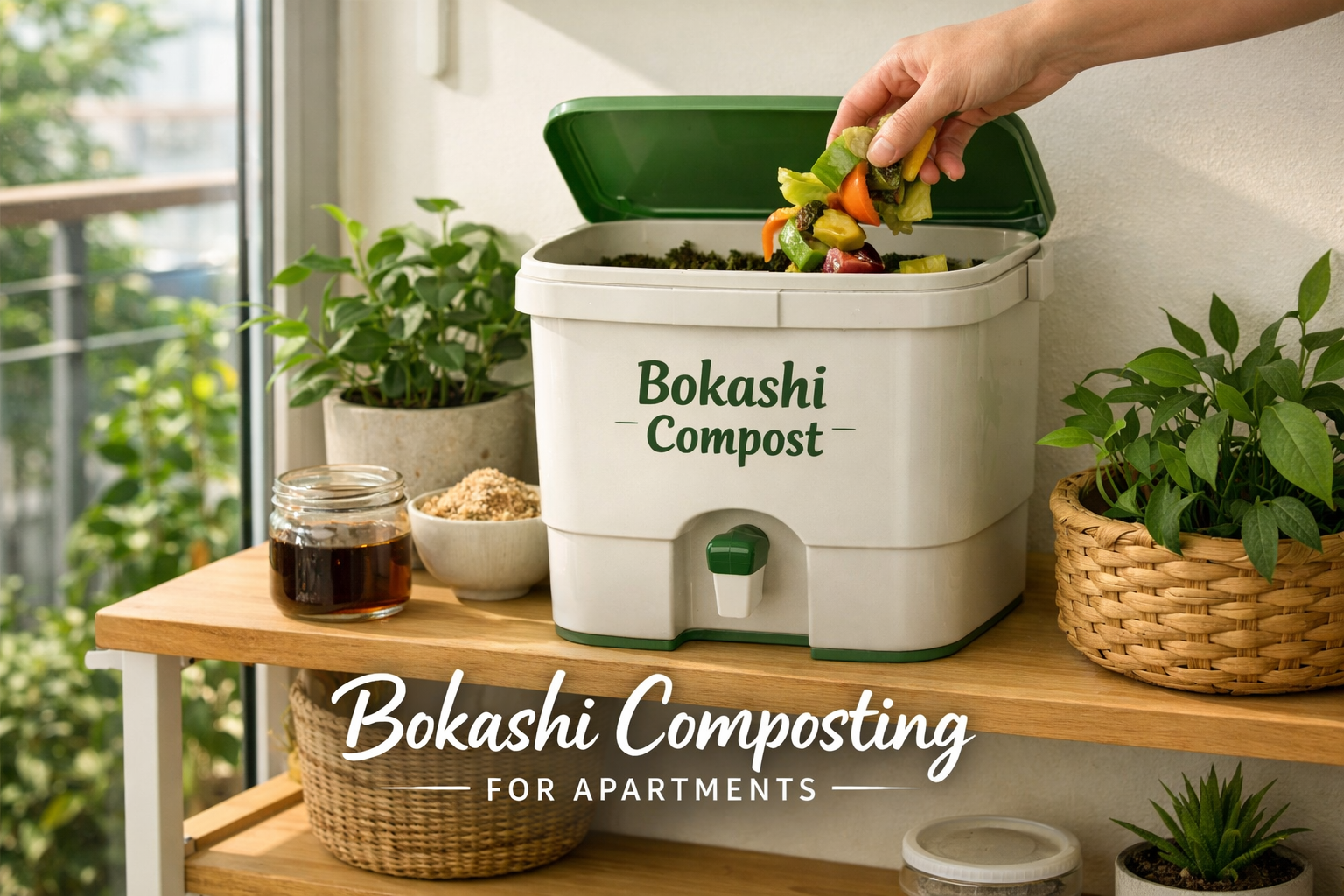
If you’ve ever wished you could compost everything from your kitchen—including leftovers, meat, or even dairy—without worrying about smell or space, Bokashi composting might be exactly what you need.
When I first discovered it, it felt like a cheat code for apartment living. No turning, no mess, and no strong odors—just a simple, sealed system that works quietly in the background.
Bokashi is especially perfect for apartments and balconies because it doesn’t rely on traditional decomposition. Instead, it uses fermentation to break down waste quickly and cleanly.
If you’re new to small-space composting in general, start here:
👉 Balcony Composting 101: Turn Scraps into Pieces of Gold
Table of Contents
What Is Bokashi Composting?
Bokashi composting is a fermentation-based method that uses beneficial microbes to break down organic waste in an airtight container. Unlike traditional composting, which requires oxygen, Bokashi works in a sealed environment.
What this means in practical terms is simple: no rotting smell, no need for turning, and the ability to compost a wider range of food waste. Instead of fully decomposing inside the bin, the waste is “pre-composted” and later integrated into soil to finish the process.
When I started using Bokashi, the biggest difference I noticed was convenience. It fits easily into daily life, especially if you’re dealing with limited space.
Why Bokashi Is Perfect for Apartments
Apartment composting comes with challenges—limited space, concern about smell, and the need for a clean system. Bokashi solves all three.
Because the bin is airtight, odors are minimal. Instead of a rotten smell, you might notice a slightly sour, pickled scent when you open the lid—which is completely normal.
Another advantage is flexibility. Unlike other methods, Bokashi can handle cooked food, meat, and dairy. This makes it one of the most complete composting systems for apartment dwellers.
From my experience, it’s the easiest method to maintain if you want something low-effort and reliable.
What You Need to Start Bokashi Composting
Getting started with Bokashi is simple and doesn’t require much equipment. You’ll need an airtight Bokashi bin (usually with a drainage tap), Bokashi bran (which contains the microbes), and your regular kitchen scraps.
The bin is typically compact enough to fit under a sink or in a corner of your balcony. The bran is what powers the process—it inoculates your food waste and starts fermentation.
When I first set mine up, I was surprised at how little space it actually took.
What You Can Compost in a Bokashi Bin
One of the biggest advantages of Bokashi composting is how flexible it is. You can compost almost all food waste, including items that are usually restricted in other systems.
This includes:
- Fruit and vegetable scraps
- Cooked food
- Meat and fish (in small amounts)
- Dairy products
- Bread and grains
However, balance still matters. Overloading your bin with large quantities of one type of waste can affect fermentation.
If you want a full breakdown of compost-friendly materials, see:
👉 What Can You Compost on a Balcony?
Step-by-Step: How to Use a Bokashi Bin
Using a Bokashi bin is straightforward once you understand the process.
Start by adding a layer of food scraps, then sprinkle a small amount of Bokashi bran over it. Press the layer down gently to remove air pockets, then close the lid tightly.
Repeat this process each time you add waste. The key is consistency—layer, sprinkle, seal.
Over time, the bin will fill up, and fermentation will begin. The entire process typically takes 2–4 weeks.
Keeping the lid tightly closed is one of the most important habits. It ensures the system stays odor-free and efficient.
Managing Bokashi Liquid (“Bokashi Tea”)
As your bin ferments, it will produce a liquid often called “Bokashi tea.” This liquid is highly concentrated and can be used as a fertilizer when diluted.
You should drain this liquid every few days to prevent buildup. If left too long, it can cause excess moisture and affect the fermentation process.
In my routine, I drain the liquid every 2–3 days and use it for my plants after dilution. It’s a great bonus product from the system.
What to Do After Fermentation
Once your bin is full and the fermentation process is complete, the contents are not yet fully composted—they need to be integrated into soil.
You can bury the fermented waste in a pot, garden bed, or large container of soil. Within 1–2 weeks, it will break down completely and enrich the soil.
If you don’t have direct access to soil, you can create a “soil factory” using a large container filled with soil and add your Bokashi waste there.
This step is where the magic really happens—the transformation into usable compost.
How to Keep Bokashi Compost Odor-Free
One of the biggest advantages of Bokashi is its low odor—but only if managed properly. If you notice strong or unpleasant smells, it usually means the system isn’t fully sealed or lacks enough Bokashi bran.
The smell should be mildly sour, not rotten. If it becomes foul, check your lid seal, add more bran, and ensure you’re draining liquid regularly.
For deeper troubleshooting, read:
👉 Why Your Balcony Compost Smells (And How to Fix It Fast)
In my experience, once you get into the habit of sealing the bin properly, odor stops being a concern entirely.
Common Bokashi Mistakes to Avoid
Like any system, Bokashi has a learning curve. One common mistake is not using enough bran. Without sufficient microbes, fermentation slows down and can lead to odor issues.
Another mistake is leaving the bin open too often. Bokashi works best in an anaerobic (no oxygen) environment, so keeping the lid sealed is essential.
Finally, forgetting to drain the liquid can create excess moisture and disrupt the process.
These are all easy to fix once you’re aware of them.
Final Thoughts
Bokashi composting is one of the most practical solutions for apartment living. It’s clean, efficient, and flexible enough to handle almost all types of kitchen waste.
If you’re looking for a low-maintenance composting method that fits seamlessly into a small space, Bokashi is a great choice. Once you understand the basics, it becomes a simple daily habit with long-term benefits.
To explore more composting options and build your full system, check out:
👉 Balcony Composting 101
Frequently Asked Questions (FAQs)
1. Does Bokashi composting smell?
No, it should have a mild sour or pickled smell—not a foul odor. Strong smells indicate a problem.
2. Can I compost meat and dairy with Bokashi?
Yes, Bokashi can handle meat and dairy in small amounts due to its fermentation process.
3. How long does Bokashi composting take?
Fermentation takes about 2–4 weeks, followed by 1–2 weeks of soil integration.
4. What is Bokashi tea used for?
It can be diluted and used as a liquid fertilizer for plants.
5. Do I need a balcony to use Bokashi?
No, Bokashi can be used indoors as long as you have space for the bin.
6. What happens if I don’t drain the liquid?
Excess liquid can disrupt fermentation and cause odor issues.
7. Is Bokashi good for beginners?
Yes, it’s one of the easiest composting methods for small spaces once you learn the basics.
Further Reading
- Bokashi Composting Study (Student Research Paper): The paper explores Bokashi composting as a sustainable method for managing organic household waste and highlights its potential to reduce waste volume and support eco-friendly waste management practices.