
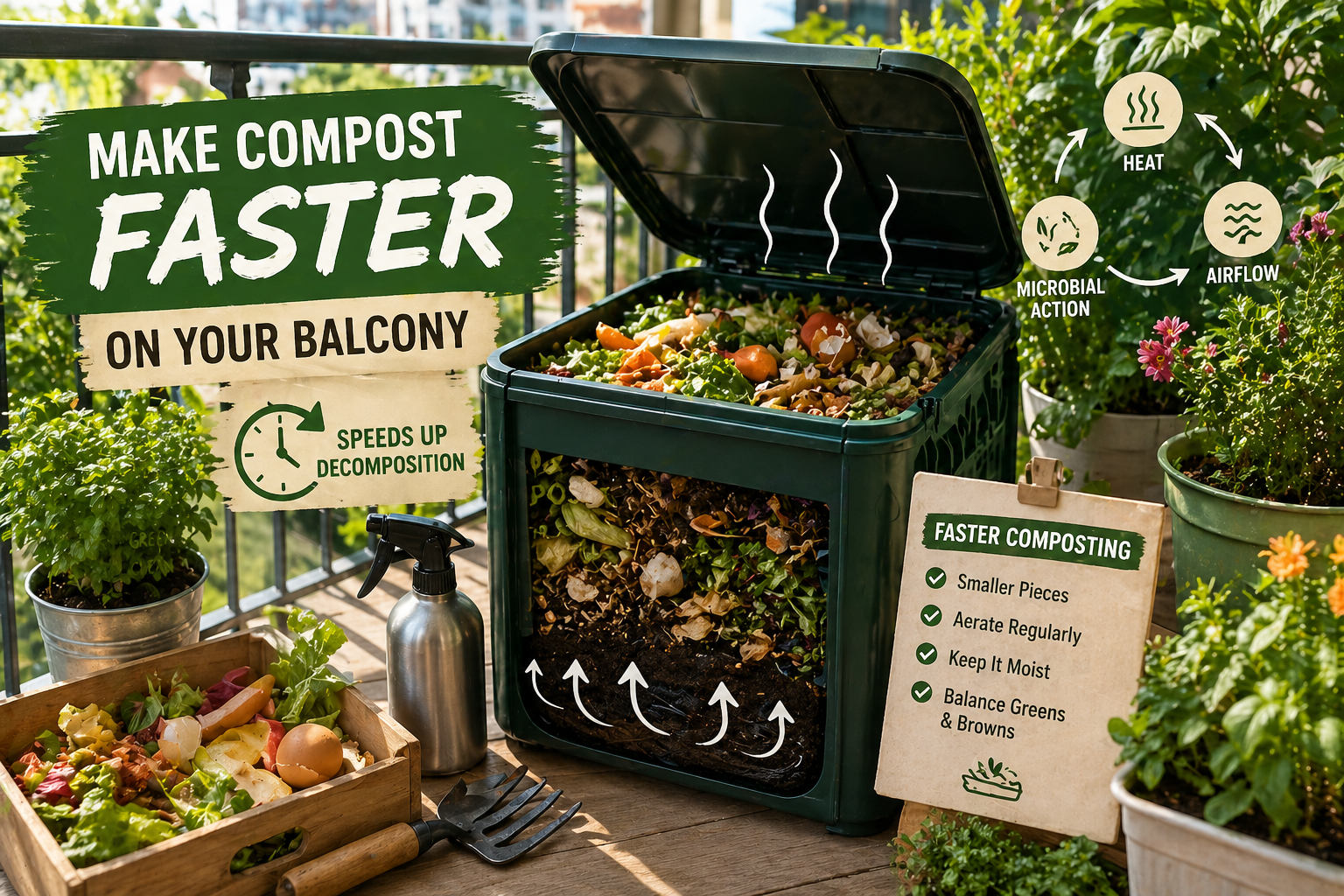
How to Make Compost Faster on a Balcony: Simple Techniques That Actually Work
One of the first questions I had when I started composting on my balcony was simple: why is this taking so long? If you’ve ever felt the same way, you’re not alone. Composting is a natural process, but that doesn’t mean it has to be slow.
With the right techniques, you can significantly speed up decomposition—even in a small balcony setup. The key is understanding what your compost needs to work efficiently and giving it exactly that.
In this guide, I’ll show you proven methods that actually work, based on real experience and practical small-space composting.
If you’re new to composting, start here first:
👉 Balcony Composting 101
Table of Contents
Why Composting Can Be Slow on a Balcony
Balcony composting tends to be slower than outdoor composting because of limited space, reduced airflow, and smaller volumes of material. These factors make it harder for heat and microbial activity to build up.
In my early setup, I noticed scraps sitting longer than expected simply because my bin wasn’t optimized. Once I adjusted a few key things, the difference was obvious—materials started breaking down much faster.
The good news is that small systems can actually become very efficient once properly balanced.
How to Make Compost Faster on a Balcony
Method 1: Chop Your Scraps into Smaller Pieces
This is one of the easiest and most effective ways to speed up composting. Smaller pieces break down faster because they have more surface area for microbes to work on.
Instead of throwing in whole peels or large scraps, take a few seconds to chop them up before adding them to your bin.
I didn’t do this at first, and it made a noticeable difference once I started. Even a rough chop can cut composting time significantly.
Method 2: Maintain the Right Balance (Greens and Browns)
Compost works fastest when the balance between greens (nitrogen) and browns (carbon) is just right. Too many greens slow things down and cause odor, while too many browns can make decomposition sluggish.
A simple ratio that works well is about 2 parts browns to 1 part greens.
If you’re unsure what materials fall into each category, check:
👉 What Can You Compost on a Balcony?
Getting this balance right is one of the biggest factors in speeding up your compost.
Method 3: Improve Airflow
Oxygen is essential for fast decomposition. Without enough airflow, your compost becomes compacted and slows down.
In small balcony bins, this happens easily—especially if you don’t mix the contents.
I make it a habit to gently stir or loosen my compost every week or two. It only takes a few minutes but keeps everything active and breaking down efficiently.
Method 4: Control Moisture Levels
Compost should be moist but not wet. If it’s too dry, decomposition slows down. If it’s too wet, airflow is reduced and things can turn anaerobic.
The ideal texture is like a wrung-out sponge.
If your compost is too wet, add more browns. If it’s too dry, lightly add water or more fresh scraps.
If you notice odor along with moisture issues, this guide can help:
👉 Why Your Balcony Compost Smells (And How to Fix It Fast)
Method 5: Use the Right Composting System
Some composting methods are naturally faster than others.
- Bokashi composting can ferment waste in as little as 2–4 weeks
- Worm composting produces usable compost in 2–3 months
- Traditional bins may take longer depending on conditions
If speed is your priority, choosing the right system makes a big difference.
Method 6: Add Compost Accelerators (Optional)
If you want an extra boost, you can add natural compost accelerators. These include things like finished compost, garden soil, or even coffee grounds.
These materials introduce beneficial microbes that help kickstart decomposition.
In my experience, adding a small handful of existing compost to a new batch helps everything break down faster.
Method 7: Keep a Consistent Routine
Consistency is often overlooked, but it plays a huge role in how fast your compost develops. Irregular feeding, neglecting airflow, or ignoring moisture can slow everything down.
A simple routine works best:
- Add scraps regularly (not all at once)
- Cover with browns
- Check moisture weekly
- Mix occasionally
Once you stay consistent, your compost system becomes more efficient over time.
My Personal Experience Speeding Up Compost
At one point, my compost felt stuck—scraps just sat there without breaking down. Instead of starting over, I made a few simple changes: I chopped my scraps, added more browns, and started mixing regularly.
Within a couple of weeks, the difference was clear. The compost became darker, softer, and more active.
That’s when I realized that speed isn’t about doing more—it’s about doing the right things consistently.
Final Thoughts
Making compost faster on a balcony isn’t about shortcuts—it’s about optimizing the process. By improving airflow, balancing materials, and maintaining proper moisture, you can dramatically reduce composting time.
Start with simple adjustments and observe how your system responds. Once everything is balanced, composting becomes faster, cleaner, and far more rewarding.
Frequently Asked Questions (FAQs)
1. What is the fastest composting method for balconies?
Bokashi composting is the fastest, followed by worm composting.
2. Can I speed up compost without special tools?
Yes, simple steps like chopping scraps, balancing materials, and improving airflow make a big difference.
3. How often should I mix my compost?
Once every 1–2 weeks is enough for small balcony systems.
4. Does sunlight help composting speed?
Indirect warmth can help, but direct heat may dry out your compost.
5. Can I compost faster in a small bin?
Yes, if properly managed, small bins can be very efficient.
6. What slows down compost the most?
Too much moisture, poor airflow, and unbalanced materials are the biggest causes.
7. How long should compost take on a balcony?
Depending on the method, anywhere from a few weeks (Bokashi) to a few months (worm or traditional compost).
Further Readings
- Making and Using Compost (University of Missouri Extension)
A detailed guide explaining how compost is formed, how decomposition works, and how gardeners can use compost to improve soil structure, fertility, and plant growth. - Do’s and Don’ts of Composting (Iowa State University Extension)
A practical guide that outlines correct composting practices and common mistakes to avoid in order to produce healthy, balanced, and effective compost.